

What if difficulty focusing on a busy shift isn’t a personal failing, but a sign your strategies were built for a different kind of work? A practical ADHD guide for nurses should account for interruptions, handovers, fatigue, and priorities that can change in minutes. Advice designed for a quiet desk and a predictable routine can feel like one more thing to fail at.
The pressure is real. You may know what helps in theory, then lose the thread when the call bell rings, documentation piles up, or a shift runs long. Start by identifying the work moments that create the most friction, then look for ideas you can use without adding a demanding routine. Self-help can offer practical support, but it isn’t a substitute for personalised care.
This guide covers small strategies, how to assess a resource, and how to decide whether it fits your work. It also introduces ADHD on Shift: A Practical Guide, a downloadable self-help e-book by Philip Lye for shift workers. The aim isn’t to fix you. It’s to find support that respects both ADHD and the realities of nursing.
Key Takeaways
- Look for guidance that can flex around interruptions, changing tasks, and uneven shift routines.
- Use a simple checklist to assess nursing relevance, clear language, practical steps, and honest limits.
- Make a demanding week more manageable by choosing one friction point and testing one relevant idea.
- A useful ADHD guide for nurses offers work-focused self-help, not a diagnosis or treatment.
- ADHD on Shift: A Practical Guide is a downloadable resource for adults with ADHD who work shifts.
ADHD Nursing Guide: Real Clinical Work Focus
A shift can change shape before you’ve finished the first task. An interruption pulls you away from charting. A handover brings new details to hold in mind. Another request arrives while the plan you made at the start of the shift is already out of date. That friction can be exhausting, especially when you’re also managing fatigue and a demanding workload.
It doesn’t automatically mean you’re careless or unsuited to nursing. Clinical work can place heavy demands on attention and task-switching. Staffing, noise, unclear priorities, and limited recovery time can add pressure. An ADHD guide for nurses should help you consider the work environment as well as what feels difficult, rather than framing every struggle as an individual failure.
Shift-aware ADHD guidance is practical self-help that considers how attention-related challenges meet the interruptions, changing demands, and variable routines of shift work. It offers a way to reflect on work situations, not a standard every nurse must meet.
Which parts of nursing work can feel especially demanding?
Pressure points vary. One nurse may find it hard to return to a task after an urgent interruption. Another may lose their place when several requests arrive at once. A handover can require listening, sorting new information, and deciding what needs attention next. Charting may be difficult to pick back up after repeated interruptions, even when its importance is clear.
These examples describe possible friction, not universal ADHD traits or evidence of unsafe practice. They also don’t happen in a vacuum. A long shift, a noisy environment, a heavy patient load, or priorities that keep changing can make it harder to keep track of the next step. Instead of asking, “Why can’t I just focus?”, try asking, “Where does the work become hardest to hold, and what conditions are adding pressure?”
That distinction makes reflection more grounded. Notice when the thread gets lost: during a transition, while trying to document, or when requests compete. You’re not assigning blame. You’re identifying where support or a different approach may be worth considering.
What a self-help guide can and cannot do
A practical guide can provide prompts for noticing patterns and strategies to consider at work. It can help you think through what might fit your role, energy, and shift pattern. Keep the bar modest: an idea should be understandable and possible to test without becoming another demanding routine.
Self-help material cannot diagnose ADHD or replace treatment or personalised care. A guide is a resource for reflection, not a clinical assessment or a promise of improved performance. ADHD on Shift: A Practical Guide is a downloadable self-help e-book by Philip Lye for adults with ADHD who work shifts. It provides practical support, not diagnosis or treatment.
What makes ADHD advice usable across nursing shifts?
A strategy can sound sensible on paper and still fall apart when a call interrupts, a task changes, or the shift stretches beyond its expected shape. That doesn’t mean the strategy is useless or that you haven’t tried hard enough. It may assume more quiet, time, and predictability than clinical work allows.
A usable strategy is clear, adjustable, and easy to restart after an interruption. That’s a better test than whether it works perfectly every day. A helpful ADHD guide for nurses should offer ideas you can adapt to your workload, not another rigid schedule to maintain.
Look for strategies that survive interruptions
Check whether the advice gives you a simple way back into a task. For example, a short written prompt such as “resume charting at the next section” can act as a restart point. A visible cue may be easier to return to than a complex tracking system that needs regular updates. These are examples to assess, not rules for every workplace or person.
Good advice also recognises what you can’t control. You may not be able to prevent interruptions, set the pace of incoming requests, or protect uninterrupted time. A strategy should help you regain your place when circumstances allow, without implying that every disruption is yours to solve.
Check whether the advice adapts to changing routines
Some shifts begin at different times, involve different responsibilities, or have different rhythms. Look for principles that can move with you, such as choosing a clear cue for restarting a task, rather than a timetable that assumes each day follows the same pattern. An approach that depends on a perfect start or a fixed sequence may be difficult to use when the work changes.
Before adopting an idea, ask yourself:
- Can I understand the next step quickly, even when I’m tired?
- Can I use it without setting up and maintaining a complicated system?
- If an interruption breaks the routine, can I return without starting over?
- Can the idea flex across different responsibilities or shift times?
These questions help separate a flexible principle from a demanding routine. They also keep expectations grounded: a useful strategy can support you, but it can’t remove workplace pressures or guarantee a particular outcome. For authoritative information about ADHD symptoms, diagnosis, and treatment, the CDC’s ADHD information is a useful reference.
If night work is your main concern, look for guidance focused specifically on ADHD and night shifts rather than assuming a daytime routine will transfer unchanged. For broader support around adult ADHD and shift work, explore ADHD on Shift: A Practical Guide. Choose the ideas that feel relevant. The point is to find an approach that can bend with the shift, not one more standard you have to meet.
How to compare ADHD guides for nurses without being misled
A polished title or confident promise doesn’t tell you whether a resource will fit your working life. Use a few grounded checks instead. The aim isn’t to find a perfect guide, but to see whether the advice is relevant, understandable, flexible, and honest about its limits.
Use a checklist to assess relevance and clarity
Look for examples that reflect nursing work, not productivity advice written only for uninterrupted desk time. Does the guidance make sense when priorities shift or a routine changes? Does it distinguish strategies an individual might try from pressures created by workload, staffing, or the work environment? Those differences matter. They keep useful reflection from becoming another reason to blame yourself.
| What to assess | Useful signs | Caution flags |
|---|---|---|
| Nursing relevance | Examples connect to clinical work and changing demands. | Advice stays broad and treats every job like predictable desk work. |
| Shift flexibility | Ideas can adapt to different responsibilities and routines. | A rigid schedule assumes each shift follows the same pattern. |
| Plain language | Steps are easy to understand and put into your own words. | Jargon or vague instructions make the next action unclear. |
| Practical steps | Suggestions are specific enough to consider without heavy setup. | The system requires constant tracking or upkeep without explaining why. |
| Honest scope | The resource clearly presents itself as education or self-help. | It promises a cure, guaranteed results, or diagnosis without appropriate support. |
Read a sample or description with a tired-shift mindset: could you grasp one idea quickly, and could you adapt it if the day changed? An ADHD guide for nurses should help you judge whether a suggestion fits, not insist that you follow it exactly. Watch for shame-based language, too. Advice that frames difficulty as laziness or lack of discipline can turn a practical problem into a verdict on your character.
Recognise the limits of self-help
A PDF guide can provide educational support, reflection prompts, and practical ideas. It isn’t individual clinical advice. Self-help material can’t diagnose ADHD or replace treatment, and testimonials or broad promises aren’t proof of clinical effectiveness. Look for a clear boundary between general guidance and claims about diagnosis or care. That honesty is part of what makes a resource more trustworthy.
Use the table as a filter, not a scorecard. A guide may be strong in one area and less useful in another. Keep the parts that feel clear and relevant; set aside what doesn’t fit your role or circumstances. A useful resource leaves room for your judgement and doesn’t make support sound like another performance test.
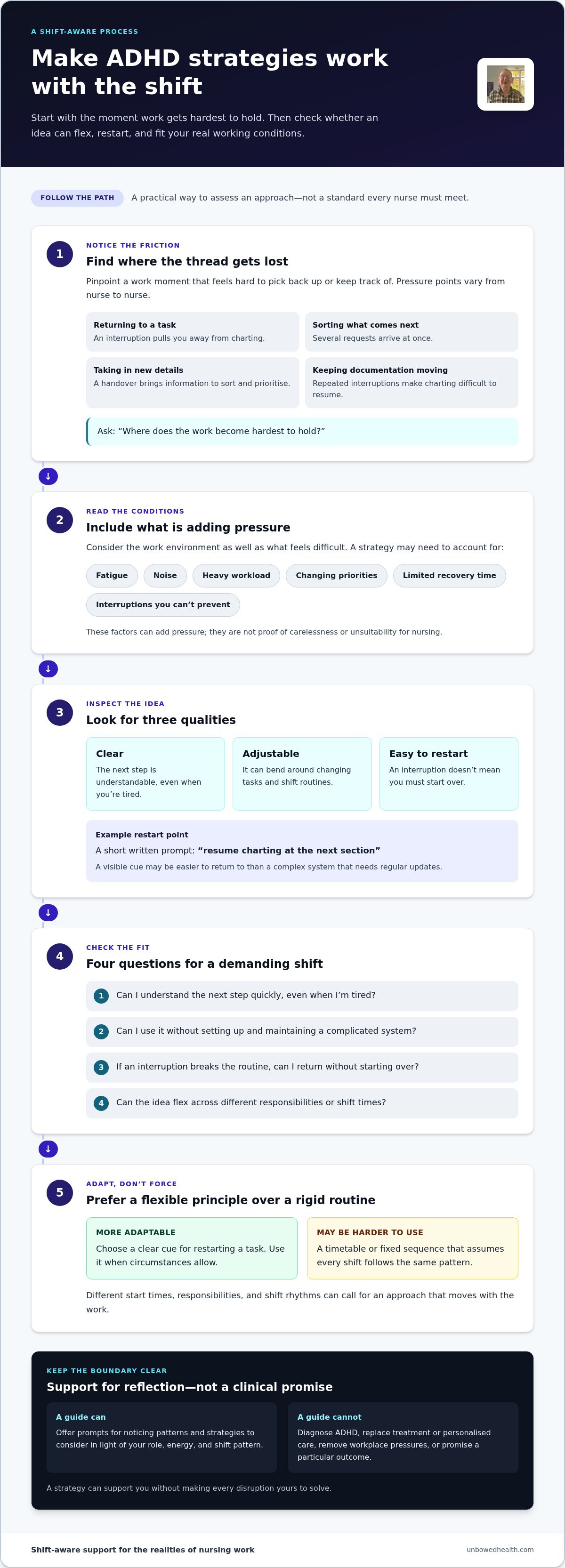
Quick ADHD Checklist for Demanding Nursing Weeks
A demanding week isn’t the time to redesign your whole routine. Keep the experiment small: notice one recurring snag, test one relevant idea, and decide whether it’s worth keeping. If a strategy doesn’t fit your role or setting, adapt it or let it go. That’s useful information, not a failure.
Choose one pressure point before choosing a strategy
Start with a moment that regularly feels harder than it needs to. It might be getting back to a task after a disruption, keeping track of the next step, or finding a place to resume after a busy handover. Name the situation plainly. You don’t need to solve every source of strain at once.
If it helps, make a brief note after the shift or during a quiet moment. Keep it general and don’t record patient names or other sensitive details.
- Situation: What kind of work moment felt difficult?
- Pressure: What seemed to add friction, such as fatigue, competing requests, or a change in priorities?
- Possible support: What small cue or adjustment might make that moment easier to return to?
This is a way to spot a pattern, not a demand to keep a detailed log. A few words may be enough. If you’re too tired to write anything down, simply noticing the pressure point still counts.
Test, adjust, and keep only what helps
Choose one low-effort idea that fits the situation. For example, you might try leaving yourself a brief, non-sensitive reminder of the next step when you pause a task, if that’s appropriate in your work setting. Don’t add several new systems at once. If the idea creates more upkeep than support, simplify it or stop using it.
After you’ve had a chance to try it, ask: did this reduce friction in that moment, or did it add another thing to remember? You’re checking fit, not measuring clinical performance or proving that a strategy works for everyone. A demanding week may make it hard to tell. You can pause and revisit the idea later.
Keep the sequence simple:
- Identify one work situation that feels sticky.
- Choose one idea that fits that situation.
- Try it in an appropriate context, without forcing it.
- Review whether it felt useful, then keep, adjust, or drop it.
A dedicated ADHD shift-planning checklist can help structure this reflection. For advice focused on the demands of a 12-hour shift, choose guidance on managing ADHD during 12-hour nursing shifts. A narrower focus can add detail without turning a small test into a full planning system.
For practical self-help for adult ADHD and shift work, explore ADHD on Shift: A Practical Guide. Use it at your own pace and focus on the ideas that feel relevant to your work.
ADHD on Shift: Practical Shift-Aware Support Guide
ADHD on Shift: A Practical Guide is an Unbowed Health e-book by Philip Lye for adults with ADHD who work shifts. Its focus makes it relevant to nurses looking for support that takes variable work hours into account, rather than assuming every workday follows the same routine.
A title alone can’t tell you whether a resource fits your needs. Consider what kind of support you want right now. Are you looking for general ideas to reflect on work, attention, and shift routines? Or do you need individual guidance about diagnosis, treatment, or your personal health? Those are different needs, and a self-help e-book has a specific role.
Who may find this shift-work guide relevant?
Nurses and other shift workers exploring practical self-help for adult ADHD may find the topic relevant. You don’t need to treat a book as a diagnostic tool to use general reflection prompts or consider workplace strategies. No resource can promise to suit every person, role, or clinical setting. Your own circumstances matter.
The guide’s shift-work focus is relevant if your work hours or routines vary and you want educational support framed around adult ADHD. Read the description with your own needs in mind. A resource can be relevant without being a complete answer, and it’s reasonable to set aside anything that doesn’t fit.
Decide whether this resource fits your next step
Ask what you want a guide to do. If you’re seeking practical self-help you can consider at your own pace, an e-book is one option. If your next step is an assessment or individual care, a self-help resource isn’t a substitute. It doesn’t diagnose ADHD, provide therapy, or offer personalised medical care.
ADHD on Shift: A Practical Guide is available as a downloadable PDF after purchase. Treat it as educational support that may complement, but cannot replace, individual medical or psychological care. Decide whether this is the kind of support you’re looking for.
If practical self-help for adult ADHD and shift work fits your current needs, explore ADHD on Shift: A Practical Guide. It’s a resource to use at your own pace, not a test you need to pass or a promise of a particular outcome.
Choose a Next Step That Fits Your Shift
You don’t have to rebuild your whole working day to make a change. Start with one point of friction and give yourself room to decide what kind of support feels useful. A good ADHD guide for nurses should meet you in the reality of your work, not ask you to prove you can follow a perfect routine.
If practical self-help for adult ADHD and shift work feels like a helpful next step, take a look at ADHD on Shift: A Practical Guide. It’s a practical resource, not a requirement or a replacement for care that’s specific to you.
Explore ADHD on Shift: A Practical Guide at your own pace. Keep what feels relevant, leave what doesn’t, and remember: difficulty under pressure is not a measure of your worth. Small, thoughtful steps count.
Frequently Asked Questions
Can nurses with ADHD work safely?
ADHD alone doesn’t determine a nurse’s ability or safety at work. People differ, and individual circumstances, workplace supports, fatigue, and the demands of a particular role all matter. A difficult shift or someone’s diagnosis isn’t enough to judge their practice. If a specific work concern arises, focus on the situation and appropriate workplace processes rather than assumptions about ADHD. A self-help resource can support reflection, but it can’t assess an individual’s clinical needs or replace professional guidance.
Is an ADHD self-help guide a substitute for diagnosis or treatment?
No. A guide can share general information and ideas, but it can’t assess symptoms, diagnose ADHD, or provide personalised treatment. If you’re considering whether your experiences may relate to ADHD, or have questions about care, discuss them with a qualified health professional. Use a guide as one possible source of self-help, not as a clinical decision. It can’t promise a particular result, since people and their circumstances vary.
Can shift work make ADHD-related difficulties feel harder?
It can for some people. Changing schedules, interrupted rest, or shifts with different demands may make attention or organisation feel more difficult at times, though experiences vary. For example, a routine that feels manageable during one work pattern may be harder to maintain when start times change. That alone doesn’t establish ADHD or explain every concentration difficulty. Consider the broader context, including sleep and workload, rather than drawing conclusions from one tough shift.
Do I have to tell my manager that I have ADHD?
There isn’t one answer that fits every nurse or workplace. Disclosure choices depend on personal circumstances, workplace policies, and applicable local rules. Before deciding, consider what support you’re seeking, what information you’re comfortable sharing, and the relevant workplace process. You may want to understand how a request for support is handled before choosing what to disclose. This FAQ and an ADHD self-help guide aren’t legal advice and can’t decide what’s right for you.
Can an ADHD guide help if I have not been diagnosed?
A general resource may help you reflect on work habits and consider practical ideas, even if you haven’t received an ADHD diagnosis. But it can’t tell you whether you have ADHD. Concentration and organisation can be affected by many factors, including stress, sleep, and workload. If these difficulties concern you or affect your wellbeing, seek an appropriate clinical assessment instead of treating a checklist or guide as a diagnostic test.
What should I do if an ADHD strategy does not work on shift?
A strategy not fitting one situation doesn’t mean you’ve failed. The task, timing, workload, or work setting may make that approach impractical. For example, a reminder that helps during a quieter period may be easy to miss during a demanding stretch. Notice what got in the way, then consider adjusting one part or setting the idea aside. A strategy is an option to test, not a rule or guarantee.

