

What if getting through a night shift with ADHD depended less on willpower and more on the supports you set up before fatigue hits? When focus slips, a task feels hard to start, or the next step disappears from memory, it can be easy to blame yourself. But ADHD on night shift can bring a predictable collision: ADHD can make attention, time, and transitions harder to manage, while overnight work may leave you low on energy.
If the shift gets harder as the hours pass, that isn’t proof you’re failing. You don’t need a perfect routine or more pressure. You need a few reliable supports that make the next task easier to see and start.
This article explains why night work can add friction and shares practical ways to reduce it. You’ll learn how to use visible prompts, make task transitions clearer, and finish with a steadier handoff and a more manageable recovery plan. The goal isn’t to force yourself through every rough patch. It’s to make the shift easier to navigate, one step at a time.
Key Takeaways
- Understand why ADHD on night shift can make focus, time awareness, and task transitions feel harder, without treating those struggles as personal failure.
- Learn how the body’s internal clock and fatigue can affect an overnight shift, and why tiredness and ADHD symptoms shouldn’t automatically be treated as the same thing.
- See why visible prompts, checklists, and supplies placed where you need them can work better than relying on memory alone.
- Explore seven adaptable ways to reduce friction overnight, from starting routine tasks to preparing a clearer handoff.
- Build a simple plan around one recurring difficulty and one practical support, with ADHD on Shift: A Practical Guide as an additional self-help resource.
ADHD on night shift: why ordinary work routines can feel harder
Have you reread the same instruction without taking it in? Looked up and realized more time had passed than you thought? Found a routine task oddly difficult to begin, even though you know how to do it? These moments can feel especially frustrating overnight, when demands keep arriving and your energy may be changing.
ADHD can affect executive functions: the everyday mental skills involved in getting started, holding information in mind, planning steps, managing time, and shifting attention. That doesn’t mean a person with ADHD can’t do these things. It means the effort or support needed can vary with the task and setting. A general overview of Attention deficit hyperactivity disorder (ADHD) describes how it can affect attention and daily functioning, though one difficult shift can’t establish whether someone has ADHD.
Night work affects people differently. Some workers may notice that focus or timekeeping becomes harder as they grow tired; others may find their routine works well. The point isn’t that every night shift creates the same pattern. It’s that ADHD-related demands and the conditions of a particular shift can interact.
What can make a night shift feel especially demanding?
An overnight role may ask you to sustain attention, respond to interruptions, switch tasks, and remember what needs doing next. Those demands can pull in different directions. When alertness dips, planning the next step or keeping a detail in mind may take more effort. Fatigue and ADHD-related challenges can overlap, but they aren’t identical.
For example, you might be partway through a routine check when a colleague asks a question. You answer, return to the task, then have to work out where you left off. In another role, the interruption might be a call, a customer, or a change in priority. The details differ, but the mental reset can still take effort.
ADHD at night is not a character flaw
Missing a step, taking longer to restart, or losing track of time can invite harsh labels: careless, unreliable, unmotivated. Those labels don’t explain what happened. A task may have been interrupted, its next step may not have been visible, or several demands may have landed at once. The way work is organized, including its pace, handoffs, and frequency of interruptions, can shape how manageable a shift feels.
Needing structure is not a personal failure.
That distinction matters. Blame adds pressure, but it doesn’t make the next instruction easier to remember. A clearer sequence, a visible prompt, or a moment to reorient can make a task easier to pick up again. Those supports aren’t evidence that you don’t care. They’re practical ways to match the work environment to the demands of the job and the way your attention is working that night.
How ADHD, fatigue, and the body clock can interact overnight
A night shift asks you to work while your body’s timing system may be preparing for sleep. That can create extra strain, but it doesn’t affect everyone in the same way. Understanding the difference between attention patterns, fatigue, and circadian timing can help you choose useful supports instead of drawing conclusions about yourself from one difficult shift.
Why overnight timing can affect alertness
Your circadian rhythm is the body’s internal clock. It helps coordinate when you tend to feel awake and when you tend to feel sleepy across the day and night. The National Heart, Lung, and Blood Institute’s overview of circadian rhythms explains how this timing system is linked to the sleep-wake cycle. Working overnight can put job demands out of step with that rhythm, though how this feels depends on the person and their circumstances.
Schedules, opportunities for sleep, health, and the environment all matter. Bright light, noise, or responsibilities outside work can affect rest, too. A routine may make parts of a shift more predictable, but it can’t guarantee that fatigue will disappear. Treat your energy as something to plan around, not a problem you should be able to overcome by trying harder.
When fatigue and ADHD-related difficulties are hard to separate
Fatigue may make it harder to concentrate, plan, remember a step, or manage frustration. Some of these difficulties can also occur with ADHD, so the same moment can have more than one possible explanation. A slower task start or a missed detail might reflect tiredness, attention demands, an interruption, or a combination. It doesn’t establish a diagnosis.
Instead of judging yourself by one rough night, notice patterns across shifts. You could briefly record when concentration dips, what was happening beforehand, and whether you’d had a chance to rest. Keep it simple. The aim is to spot useful patterns, not to monitor yourself perfectly or prove that one cause explains everything.
For people with ADHD, executive-function challenges may already make it harder to organize steps or keep information in mind. Fatigue can add another layer of effort to those tasks. This is a possible interaction, not a universal rule: one worker may feel steady overnight, while another may find particular hours or tasks more demanding. CDC’s National Institute for Occupational Safety and Health offers information on fatigue and work, including how work schedules can relate to alertness and performance.
If sleepiness, concentration problems, or mood changes persist, feel severe, or create safety concerns, consider discussing them with an appropriate health professional. They can help assess what may be contributing; a difficult shift alone can’t tell you whether ADHD, a sleep issue, or something else is involved.
For practical ideas to organize workplace challenges, ADHD on Shift: A Practical Guide is a downloadable self-help resource by Philip Lye. Use it to explore practical structure alongside the patterns you’re noticing. It isn’t a way to diagnose or treat a health condition.
ADHD on night shift: replace self-blame with useful structure
It’s tempting to treat a difficult shift as a test of discipline: if you could just concentrate harder, remember more, or push through, everything would stay on track. But a plan that depends on constant effort has a weak point. It asks you to remember what to do, when to do it, and to use the plan, even as work keeps moving around you.
Why willpower-only plans often break down
“I’ll remember to check that later” is an intention, not a cue. It leaves the task floating in your mind until later arrives. A visible prompt tied to a place or action is easier to return to: a checklist at the workstation, or supplies kept together where the routine happens. If a step gets missed, review the setup rather than treating it as proof that you didn’t care.
External reminders can carry the next step when attention is under strain.
Keep the support small and specific. Instead of creating a long list for the whole shift, choose one routine that tends to lose momentum and give it a clear cue. For example, place a short task list beside the relevant station, or use an approved reminder at the point in your workflow where you need to pause and check what comes next. Make the cue easy to see and reset.
- Vague intention: “I’ll keep track of the routine.”
- Visible support: A checklist kept with the materials used for that routine.
- Vague intention: “I’ll remember what needs restocking.”
- Visible support: A prompt in the designated restocking area, following workplace procedures.
What practical support can and cannot do
Checklists and reminders can make routine steps easier to follow and reduce the number of details you must hold in mind. They don’t replace training, required safety procedures, or your workplace’s established processes. Use tools in ways that fit those procedures, and use the appropriate workplace channels if a task or instruction is unclear.
Structure also has limits. It can’t remove interruptions, create more staffing, or make an exhausting workload manageable on its own. Fatigue and competing demands are real constraints, not problems an individual coping tool can solve. A reminder may help you resume a task, but it can’t guarantee perfect focus or error-free work. If the workload or conditions feel unsafe or unsustainable, that needs attention beyond personal organization.
For ADHD on night shift, useful structure isn’t a demand to perform perfectly. It’s a way to make the next step easier to find, especially when the shift is busy. Start with one point of friction. Put one support where it can help. Then notice whether it makes the routine more workable and adjust as needed. For more structured workplace self-help ideas, explore ADHD on Shift: A Practical Guide, a downloadable resource authored by Philip Lye.
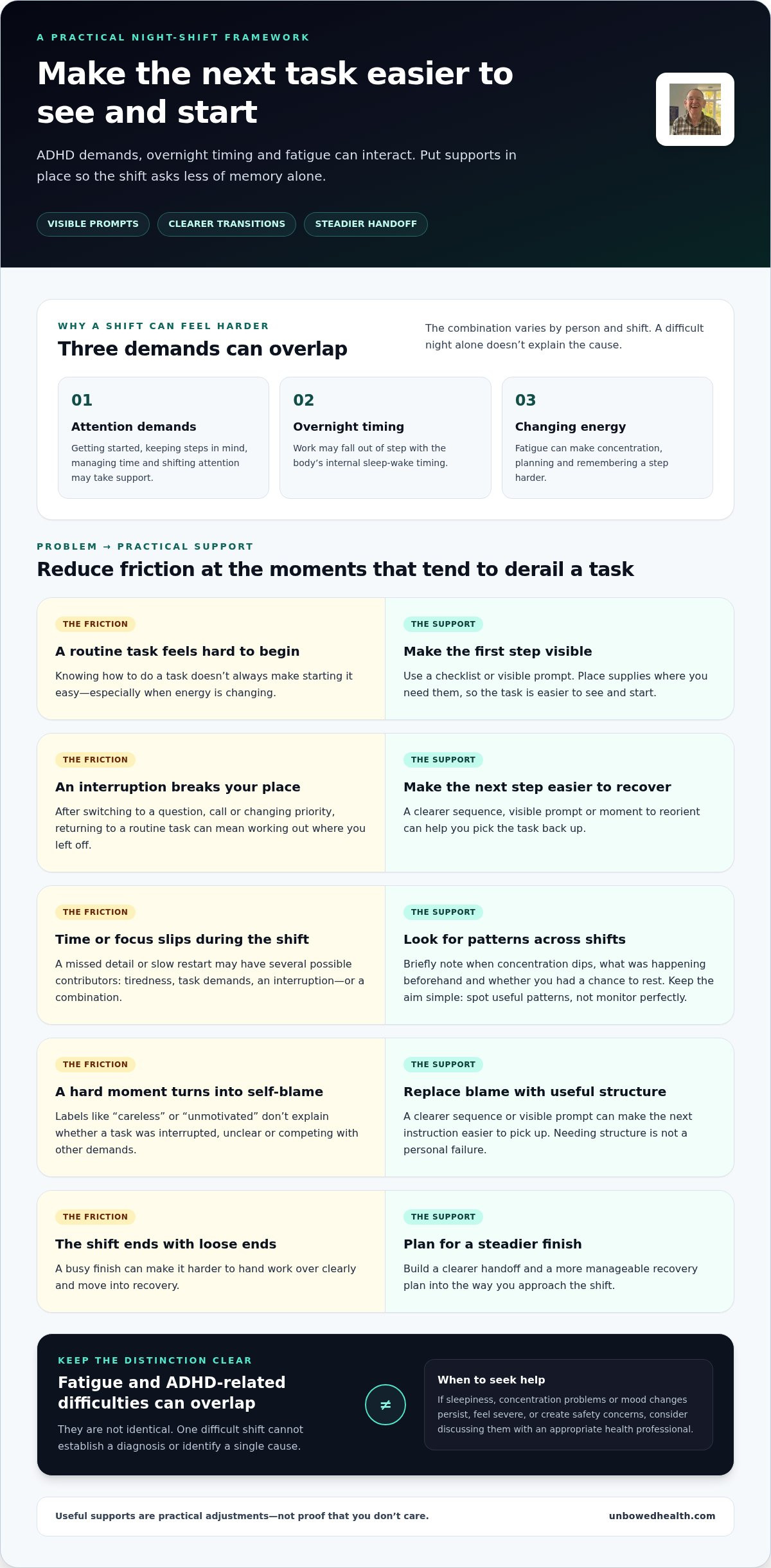
Seven practical rules for managing ADHD on a night shift
A useful routine shouldn’t require you to feel alert, organized, and motivated every minute. Pick supports that are quick to set up and easy to repeat. Adapt them to your role, and always follow workplace safety policies, training, and role-specific procedures first. The best routine is one that remains usable when energy is low.
Before and at the start of the shift
- Prepare the essentials. Before work, put the items you’re allowed to bring or use in one consistent place. For example, gather your badge, keys, and any permitted work materials together so you’re not searching as you leave.
- Choose one first task. Write a short starting point rather than planning every hour. In a warehouse, that might be reviewing the shift’s assigned priorities; in an office, it could be opening the task list you use at work.
- Use one transition cue. Attach a reminder to a reliable event, such as arriving at your station or finishing a scheduled check. A watch alert or approved workplace prompt can signal, “Pause and review what comes next.”
- Keep setup small. Choose only the tools you can realistically maintain on a difficult day. A short checklist in an approved location is more useful than an elaborate system you have to rebuild every shift.
During the shift and at handoff
- Break the next task into a visible action. Replace “finish the report” with the next permitted step, such as “open the report and check the unfinished section.” This gives you a clearer place to restart after an interruption.
- Mark progress as you go. Use a checklist, status field, or other approved method to show what’s complete and what remains. In a service role, for example, update the designated task record after completing each routine stage, following workplace procedures.
- Leave a clear handoff. Before ending your shift, record unfinished tasks, relevant updates, and the next action for the incoming worker. Use only approved systems and protect confidential information. For example, note that a task is pending and where the next worker should find its current status, without putting private details in an unsecured note.
These rules are supports, not guarantees. They can reduce the effort of remembering and restarting, but they can’t remove fatigue, interruptions, or an unmanageable workload. If a tool conflicts with safety requirements or your role’s procedures, don’t use it. For more structured workplace ideas, explore ADHD on Shift: A Practical Guide, a downloadable self-help resource by Philip Lye.
Build a night-shift plan with ADHD on Shift
Strategies work best when they fit the shift you actually have, not an ideal version of it. You don’t need to rebuild your whole routine. Choose one recurring point of friction and pair it with one support you can realistically use. A small change can give you a clearer next step without adding another demanding system to maintain.
Turn one difficult moment into a workable plan
Name a moment that keeps snagging you. Maybe starting the first task takes effort, or an interruption makes it hard to pick up where you left off. Describe what happens without judging yourself. Then choose one practical support that matches that moment. Keep the plan brief enough to remember, or write it down so remembering isn’t another task.
- If getting started is hard, write down one first action before the shift.
- If you lose your place after interruptions, use an approved cue to mark where to resume.
- If handoff details slip away, set aside a moment to complete the required handoff record.
After the shift, ask yourself: Did the support help? Was it easy to use? Did it fit the actual workflow? Adjust what didn’t work. A cue that’s out of sight, too complicated, or poorly timed may need changing. That isn’t a failed plan; it’s useful information for making the next version more workable.
When a practical guide may help
Sometimes it helps to have ideas gathered in one place so you can return to them at your own pace, rather than trying to remember everything from one article during a demanding week. A guide can offer a starting point for reflecting on workplace challenges and considering which practical supports might suit your situation. It doesn’t need to become another rulebook you must follow perfectly.
ADHD on Shift: A Practical Guide is Unbowed Health’s downloadable self-help e-book, authored by Philip Lye and provided as a PDF. It offers practical workplace guidance for readers who want to explore the topic further. It’s self-help material, not a diagnosis or a substitute for clinical care. Take from it what feels useful to your circumstances.
If you’d like a resource to revisit as you shape your own approach, explore ADHD on Shift: A Practical Guide. Or begin with one small step: identify a point of friction and choose a single support to try. You can build from there at a pace that works for you.
Make your next shift a little more workable
You don’t have to solve every difficult part of overnight work at once. Choose one moment that tends to trip you up, then test one support that could make the next step easier to find. Keep what helps and adjust what doesn’t. A routine is allowed to change as your shifts and needs change.
ADHD on night shift can bring challenges that deserve practical support, not self-blame. For more ideas to revisit at your own pace, download ADHD on Shift: A Practical Guide, Unbowed Health’s self-help e-book in PDF format.
Start small. One prompt, one clearer transition, or one note for your handoff is enough for a first step. You can build from there without expecting yourself to get everything right in one night.
Frequently Asked Questions
Can night shift make ADHD symptoms feel worse?
It can make attention or planning feel harder for some people, but the effect isn’t the same for everyone. With ADHD on night shift, you might notice more difficulty during a demanding stretch, after interrupted rest, or during tasks that require sustained focus. That doesn’t prove your ADHD has changed. If you’re concerned, note what’s different and discuss persistent changes with a qualified health professional.
Does working nights cause ADHD?
No. Working night shifts doesn’t cause ADHD or establish that you have it. A demanding schedule, stress, or poor sleep can affect concentration and follow-through, but those experiences alone don’t identify their cause. If attention difficulties continue outside work or interfere with everyday life, write down a few examples and talk with a qualified health professional. They can consider your history and circumstances rather than relying on one rough stretch at work.
How can I tell whether poor focus is ADHD or sleep deprivation?
It can be hard to tell without a professional assessment because both can affect attention, memory, and completing tasks. Notice whether concentration changes with the shift, rest, or type of task, and whether similar difficulties occur away from work. These observations can help you explain what’s happening, but they can’t diagnose the cause. A qualified clinician can consider your wider health and personal history before drawing conclusions.
Should I change when I take ADHD medication before a night shift?
Don’t change your medication timing or dose based on general advice. The right approach can depend on the specific medicine, your health, and when you work and sleep. Contact the clinician who prescribes it or a pharmacist before making a change, and don’t take an extra dose to compensate unless they’ve directed you to. A brief record of medication timing, sleep, and concerns can make that conversation more useful.
Can I tell my manager that I have ADHD?
That’s a personal decision, and you don’t have to decide during a stressful moment. First, consider the practical change that might help, such as receiving priorities in writing or clarifying how tasks should be handed over. Depending on your circumstances, you may be able to discuss a work need without sharing a diagnosis. Review relevant workplace processes and privacy considerations; this isn’t legal advice, and rules vary by location.
What should I do if night shifts are affecting my wellbeing?
Take ongoing or worsening effects seriously, especially if sleepiness or distress is affecting your safety at work or on the journey home. If it feels manageable, make a note of what’s changed and arrange to discuss it with an appropriate health professional. If you’re in immediate danger, contact local emergency or urgent support. Workplace organization tools may help with tasks, but they can’t replace care for health concerns.
