

What if the problem isn’t that you can’t stick to a routine, but that your shifts keep changing the ground beneath it? A rotating roster can make sleep, meals, and task transitions harder to manage, especially when fatigue is already pulling at your attention and memory. This ADHD guide for shift workers starts from that reality, not from the assumption that every workday looks the same.
If plans fall apart when your hours change, or you blame yourself for feeling scattered after a demanding shift, that strain is real. ADHD and irregular schedules can make everyday tasks take more effort. You don’t need a rigid routine that only works during a perfect week. You need supports that are easy to adapt when your start time, workload, or energy changes.
Here, you’ll learn why changing schedules can add to the demands of ADHD and how to build a practical support plan around your actual work pattern. We’ll look at small strategies for different shifts and energy levels, ways to support rest and task transitions, and when self-help is not a substitute for individualized clinical care.
Key Takeaways
- Match your supports to a stable, rotating, or unpredictable schedule instead of forcing one routine to fit every shift.
- Use the ADHD guide for shift workers to identify practical ideas that can flex with your work pattern and energy.
- Start with one friction point, add a simple cue, then review whether it helped before changing more.
- Plan small supports around before, during, and after work without relying on a rigid timetable.
- Use self-help resources to organize ideas, while remembering they can't diagnose ADHD or replace individualized care.
ADHD and shift work: why ordinary work routines can fall apart
The rota changes again. You arrive expecting one task, then a handover adds three more. A transition slips by, your attention scatters, and by the end of the shift even simple decisions feel heavy. These moments don’t mean you’re lazy or don’t care. They can reflect friction between how work is organized and the demands it places on your attention and energy.
Shift work means working outside a regular daytime pattern. It can include early starts, overnight hours, rotating shifts, or schedules that change from week to week. Each pattern brings different pressures. A night shift puts work across usual sleep hours; a rotating schedule can keep moving the time you need to wake, eat, and prepare.
ADHD can affect executive functions: the everyday skills used to hold information in mind, decide what comes first, begin a task, and switch to another without losing the thread. Those demands don’t look the same for everyone. One worker may lose track of verbal instructions; another may find interruptions or starting a new task harder.
The setting matters, too. Frequent interruptions, rushed handovers, unclear instructions, and last-minute rota changes can make work harder for people with different attention styles. Where possible, separate what feels difficult about a task from what the work conditions are making harder. That distinction can point toward a useful support rather than another reason to blame yourself.
Work strategies can support daily tasks, but they don’t diagnose or treat ADHD. An ADHD guide for shift workers can help organize practical ideas; it isn’t a substitute for individualized clinical care.
What makes shift work different from a regular schedule?
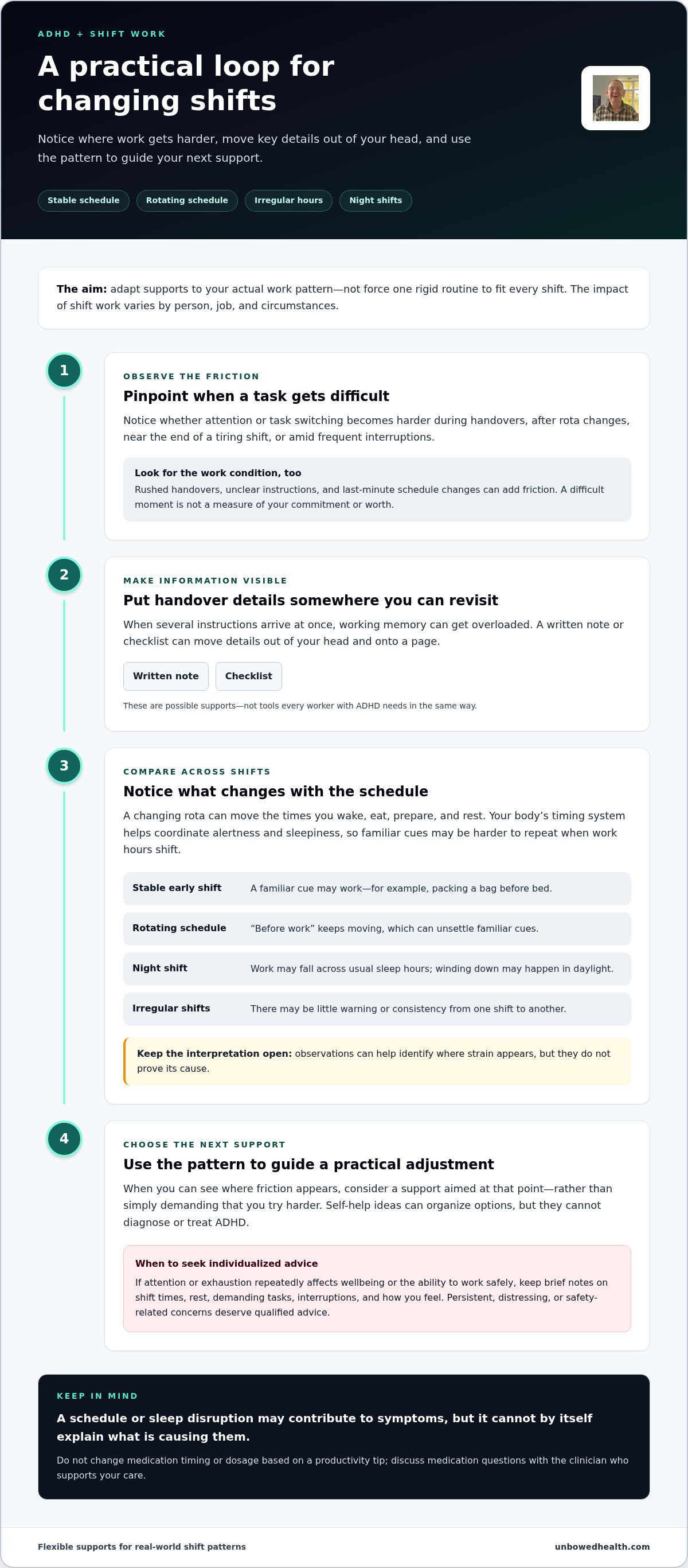
A stable early shift may allow familiar cues, such as packing a bag before bed. A rotating pattern can unsettle those cues because “before work” keeps moving. Irregular shifts may offer little warning or consistency, while night shifts ask you to work at a time that may conflict with your usual sleep pattern. The impact varies by person, job, and circumstances. For background on how disrupted sleep can affect thinking, see this overview of shift work sleep disorder and cognitive function.
How ADHD can affect work tasks without defining the worker
Imagine receiving several handover details while coworkers are speaking and equipment is running. Working memory is the mental “scratchpad” that holds those details briefly. If it gets overloaded, a follow-up task may slip your mind. A written note or checklist can move the information out of your head and onto a page. It’s one possible support, not proof that every worker with ADHD needs the same tool.
Task switching adds another layer. You might need to pause one job, respond to an interruption, then find your place again. Notice when that friction appears: during handovers, after schedule changes, or near the end of a tiring shift. The pattern can help you choose a targeted support. It describes the conditions you’re working in, not your commitment or worth.
How changing shifts can affect focus, energy, and recovery
Your body has an approximate timing system, often called the circadian rhythm. It helps coordinate patterns such as feeling alert or sleepy across the day and night. It isn’t a discipline test. A changing rota can put work, meals, and rest at different points in that timing cycle, making familiar routines harder to repeat.
Sleep is part of the picture, but it isn’t the whole explanation. Disrupted or limited sleep can make attention, memory, and self-management harder for many people. With less mental energy in reserve, prioritizing a task or shifting focus may take more effort. That doesn’t mean every difficult shift has one cause, or that night work affects everyone in the same way.
Why attention can feel different across a run of shifts
After an early shift, you might prepare the next day’s food before bed. A later start can move that routine; a run of nights can make “winding down” happen in daylight. When the cues keep changing, starting or ending familiar routines may take more thought. Fatigue can add weight to work demands that were already challenging, but the pattern varies with the job, schedule, and person.
Notice what changes across a run of shifts. Is focus harder after a short rest, during busy handovers, or when your start time moves? Does the difficulty ease when the work is quieter? These observations don’t prove a cause. They give you a clearer picture of where the strain appears, so you can consider a practical adjustment instead of simply demanding that you try harder.
When a difficult shift deserves more than another productivity tip
If attention or exhaustion is repeatedly affecting your wellbeing or ability to work safely, pause before adding another planning tool. Keep brief notes on shift times, rest, demanding tasks, interruptions, and how you feel. Patterns may help you explain what’s happening to a qualified health professional. Seek qualified advice for persistent, distressing, or safety-related concerns, especially if symptoms feel new or are getting harder to manage.
ADHD, fatigue, stress, medication effects, and other health factors can overlap in how they feel at work. A difficult stretch alone can’t tell you which factor is responsible. A schedule or sleep disruption may contribute to symptoms, but it can’t by itself explain what’s causing them. Don’t change medication timing or dosage based on a productivity tip; discuss medication questions with the clinician who supports your care.
A self-help resource can offer general ideas and frameworks to consider, but it can’t assess your situation or provide individualized clinical care. An ADHD guide for shift workers may help you organize practical supports around your schedule; it doesn’t diagnose or treat ADHD. If you want material to revisit as your shifts change, explore practical ADHD resources for shift workers alongside advice suited to your individual needs.
Choose ADHD work strategies that fit your shift pattern
A useful support should reduce one specific point of friction, not become another task to maintain. Start by asking what repeatedly gets missed, delayed, or harder to restart. Then choose one cue that fits the way your shifts actually work. A small prompt you use consistently can be more realistic than a full routine that collapses when your hours change.
Different schedules offer different anchors. A stable shift may give you a reliable start or finish point. Rotating hours can make clock-based routines less dependable, while unpredictable schedules may call for a minimum version you can use whenever work begins. Treat these as options to test, not rules you have to follow.
| Work friction | Low-effort support | Best used when |
|---|---|---|
| Forgetting steps | Place a short written prompt where the task starts. | The same steps recur or are easy to overlook. |
| Difficulty switching tasks | Use a brief handover or end-of-task cue, if your role allows. | You need to pause one task and pick up another. |
| Too many priorities | Write down the next action, not the entire workload. | The full list feels too large to start. |
| Unclear routine cues | Attach one small action to an event, such as arriving at work. | Start times change or the day feels hard to organize. |
Match the support to the friction point
Make the reminder visible at the moment you need it: a note beside the relevant station or a checklist where a repeated task begins. For a difficult transition, try a consistent closing cue, such as recording the next step before handing work over. If priorities compete, write down one concrete action you can do next. Keep prompts short enough to use when you’re tired, and adapt them to workplace procedures and safety needs.
Adapt the same support to different shifts
With fixed hours, you might connect packing your work items to leaving home or checking a task list to the start of your shift. With rotating hours, use event-based cues instead of a fixed time: after waking, before leaving, or when a handover begins. If hours are unpredictable, define a minimum version, such as checking one essential note before starting. A brief version still counts.
Test one support in the situation where it’s most useful. If it adds effort without easing the task, change the cue or let it go. An ADHD guide for shift workers can help you compare practical approaches, but your own work pattern is the measure of whether a strategy fits.
Build a practical ADHD shift plan for before, during, and after work
A shift plan doesn’t need to be a perfect timetable. It needs to help with one real snag, even when your hours or energy change. Build it around a few small choices, then adjust based on what actually happens at work.
- Identify one friction point. Choose a specific moment, such as forgetting an item before leaving, losing track of a follow-up, or finding it hard to stop one task and begin another.
- Choose one cue. Pick a reminder that fits that moment: a note by your work bag, a prompt in a task system you already use, or a brief pause at a handover.
- Test it on a real shift. Keep the cue simple. Notice whether it helped when the shift was busy or you felt low on energy.
- Review and adjust. Keep what reduces friction, change what gets in the way, and drop what becomes another burden. You’re testing a support, not grading yourself.
Before work: reduce the number of decisions
When practical, prepare one essential item or reminder in advance. That might mean putting required equipment near your bag or writing down the first work task you need to check. Choose one start-of-shift cue, such as reviewing the handover or opening your task list. If the full plan feels too heavy on a low-energy day, use its smallest version: bring the essential item and identify the first action.
During and after work: make transitions easier
During a shift, put follow-up tasks somewhere reliable rather than asking your memory to hold them through interruptions. Use a work-approved note, checklist, or task system. Before moving on, capture the next action in a few words. This can help whether you’re handling customer requests, equipment checks, project tasks, or shared responsibilities.
At the end of work, take a brief check-in if your role’s procedures allow it. Record unfinished work, note who needs the handover, and mark the next step. Follow workplace rules for confidential information and required records. Then choose a simple transition out of work, such as changing clothes, taking a few quiet minutes, or listening to something on the way home. It doesn’t need to dictate when or how you sleep. It’s simply a signal that the workday has ended.
Let the plan flex. A fixed shift might suit a cue tied to leaving home; a rotating schedule may call for a cue tied to the start of work instead of a clock time. On an unpredictable day, the minimum plan is enough. An ADHD guide for shift workers can provide practical frameworks to revisit as your pattern changes. Explore ADHD on Shift: A Practical Guide for a resource you can return to while shaping supports around your shifts.
Use an ADHD shift-work guide as practical support, not a cure
A practical guide can give scattered ideas a place to land. It can offer frameworks, help you think through work routines, and give you material to revisit when your schedule changes. It can’t diagnose ADHD, replace treatment or individualized clinical advice, or guarantee a particular result at work. A resource is there to support your thinking, not to decide what’s causing your difficulties or promise that one method will fit every job.
ADHD on Shift: A Practical Guide is a self-help resource for people looking for ways to manage ADHD-related demands alongside shift work. It offers practical advice, coping frameworks, and printable templates in a downloadable PDF format. You can return to the material around your own shifts rather than trying to absorb everything at once. It isn’t a clinical assessment or a substitute for professional care.
Who may find a shift-work guide useful?
Adults with ADHD may find a guide useful when they want practical ideas for work routines, changing schedules, and the friction that can build around a shift. It may also help readers exploring their work difficulties organize questions and notice what support they might need. Jobs, schedules, and people differ, though. A guide can offer starting points, not a personalized answer or a promise that every suggestion will suit your circumstances.
How to use a downloadable guide without adding pressure
Choose one idea that connects to a real challenge. Try it in a specific situation, then keep, adjust, or set it aside based on how it works for you. There’s no need to apply every suggestion or turn the guide into another measure of whether you’re doing enough. Revisit it when your rota, responsibilities, or main work challenge changes. What helps during a stable run of shifts may need adjusting when your hours move.
If you’re dealing with persistent distress, health concerns, or a safety issue, self-help material isn’t the right place to get an individual assessment. Seek advice from a qualified health professional, and use workplace procedures for safety-related matters. If you have questions about medication or treatment, raise them with the professional involved in your care. A guide can help you organize ideas alongside that support, but it can’t provide it.
If you’re looking for an ADHD guide for shift workers, ADHD on Shift: A Practical Guide offers a practical resource to return to as your work pattern changes. Take what fits, leave what doesn’t, and move at a pace that respects your energy. Get practical support for working shifts.
Let your next step be small enough to use
You don’t have to rebuild your whole work life at once. Choose one point in a shift that regularly catches you off guard, then decide what might make that moment a little easier. A small adjustment is still a real step, even if it only helps on some days.
If you want a resource to return to as your schedule changes, ADHD on Shift: A Practical Guide is a downloadable PDF focused on adult ADHD and shift work. Unbowed Health publications offer practical advice, coping frameworks, and printable templates. Use what fits your circumstances, and leave room for professional advice when your health, safety, or level of distress calls for more individualized support.
An ADHD guide for shift workers can’t promise a perfect routine or take away every hard shift. It can help you explore a next step without treating the difficulty as a personal failure. Explore ADHD on Shift: A Practical Guide when you’re ready. Start where you are. One workable change is enough for now.
Frequently Asked Questions
Can shift work make ADHD symptoms harder to manage?
It can make some ADHD-related difficulties feel more demanding, though the effect differs from person to person. Changing work hours may disrupt sleep or familiar cues, while fatigue and busy work conditions can add strain to focus and organization. A rough shift pattern doesn’t prove that ADHD is the cause. If you’re noticing a change, track when it happens and discuss persistent concerns with a qualified health professional.
Is an ADHD guide for shift workers only useful for nurses?
No. An ADHD guide for shift workers can be relevant to adults in any field with night, rotating, early, or changing hours. A warehouse worker might need a reliable way to remember equipment checks; a hospitality worker might want help keeping track of changing tasks during service. Useful ideas are tied to work demands and schedule patterns, not one profession. Adapt suggestions to your duties and workplace procedures.
What can I do if I suspect I have ADHD but have not been assessed?
Start by noting specific examples, such as missed deadlines, difficulty organizing tasks, or losing track of instructions, and where they occur in your life. Include what helps and whether the challenges change with workload or rest. Share those observations with a qualified health professional and ask about an appropriate assessment. Self-reflection can help you prepare, but it can’t confirm ADHD. You deserve support without having to settle the question alone.
Can I ask my employer for adjustments to help with ADHD at work?
You can raise a work-related support request, though the process and protections depend on your location and workplace. Focus on the barrier and a practical change that could help, such as written task instructions, fewer avoidable interruptions, or a clearer handover. You don’t have to begin with a long explanation. Check your workplace’s process, and consider keeping a record of the request and any agreed next steps.
Will an ADHD shift-work guide replace treatment or therapy?
No. A guide offers general information and ideas to consider; it can’t assess your needs, provide treatment, or replace individualized care. If you already receive support, you can use a guide to help organize questions about how work schedules affect you. Bring health or medication concerns to a qualified professional rather than relying on self-help material to make clinical decisions. The resource should support your choices, not stand in for care.
How do I use strategies when my shifts change every week?
Choose a cue that follows an event instead of a clock time. For example, link a brief check of your work essentials to the moment you leave home, whether the shift starts early or late. When the rota arrives, identify any unusual demands and adjust only what needs changing. Keep the cue easy to move or repeat, so a schedule change doesn’t require rebuilding your whole system.
What is ADHD on Shift: A Practical Guide?
ADHD on Shift: A Practical Guide is a downloadable PDF self-help resource from Unbowed Health for adults interested in ADHD and shift work. It provides practical advice, coping frameworks, and printable templates that readers can revisit as work demands change. It doesn’t diagnose ADHD, promise workplace results, or replace treatment or individualized clinical guidance. Use it as an educational resource, and seek professional advice for personal health concerns.